

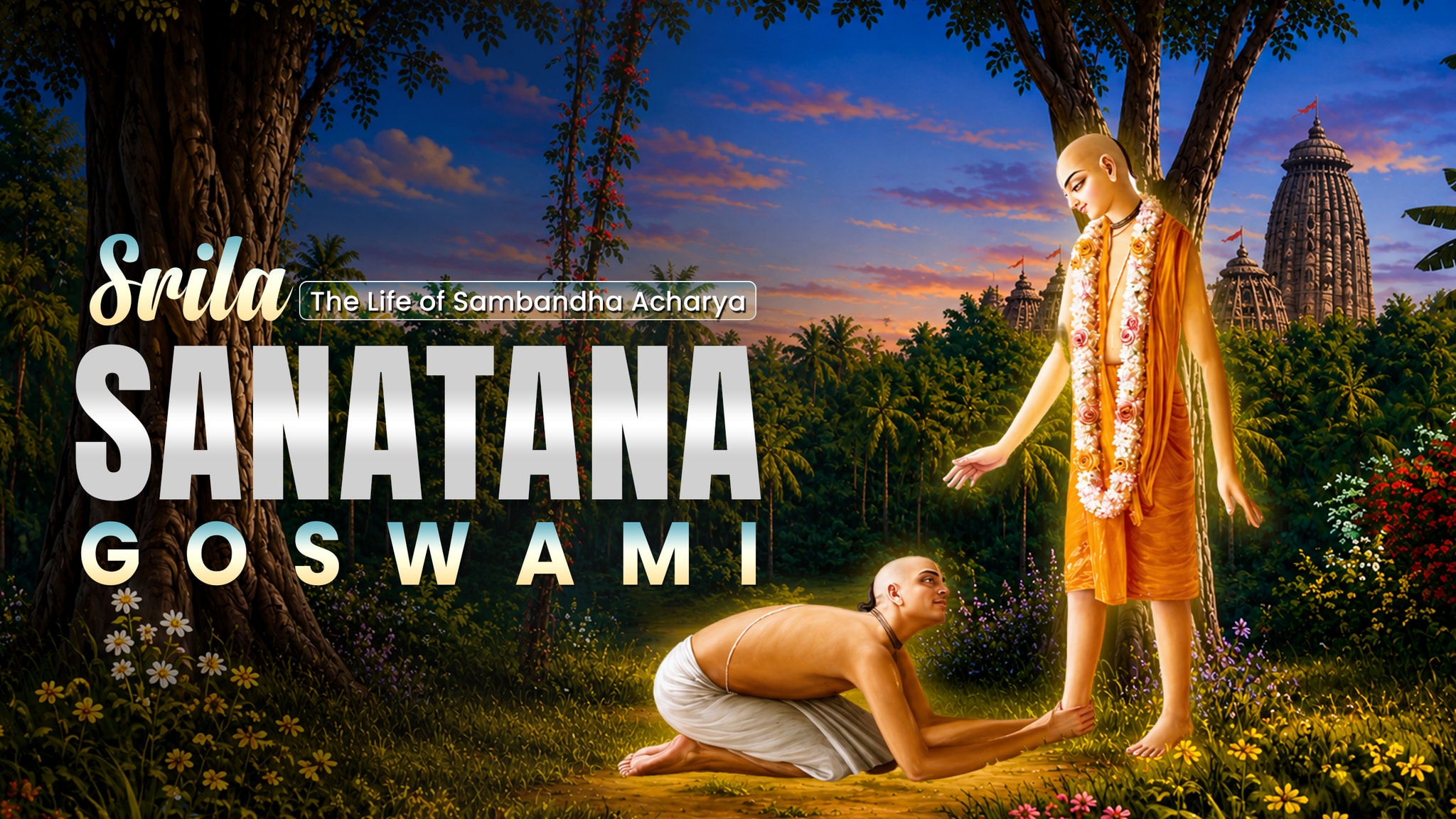
Śrīla Sanātana Goswami is revered as one of the Six Goswamis of Vrindavan and one of the foremost disciples of Sri Chaitanya Mahaprabhu. His life is a remarkable example of humility, scholarship, renunciation, and unwavering devotion to Lord Krishna. Following the order of Sri Chaitanya Mahaprabhu, he dedicated his life to rediscovering the holy places of Vrindavan, establishing Vaishnava philosophy, and composing timeless devotional scriptures that continue to guide devotees around the world.
Identity of Śrīla Sanātana Goswami
ya rūpa-mañjarī-preṣṭhā
purāsīd rati-mañjarī
sādyā gaurābhinna-tanuḥ
sarvārādhyaḥ sanātanaḥ
Gaura-gaṇoddeśa-dīpikā (181)
Kavi Karnapura reveals that Śrīla Sanātana Goswami is the incarnation of Rati Mañjarī (Lavanga Mañjarī), an intimate associate of Srimati Radharani in Krishna's eternal pastimes. He is also understood to embody the qualities of the sage Sanātana Kumāra, making him one of the most exalted associates of Sri Chaitanya Mahaprabhu.
Early Life of Śrīla Sanātana Goswami
Śrīla Sanātana Goswami appeared in 1488 CE in a respected Saraswat Brahmin family. His parents were Kumardeva and Revatidevi. Along with his brothers Śrīla Rūpa Goswami (formerly Santosha) and Śrī Vallabha (Anupama), he displayed extraordinary intelligence and devotion from childhood.
Although their ancestral roots were in Karnataka, the family later settled in Bengal, where the brothers received an exceptional education in Sanskrit literature, logic, philosophy, rhetoric, and especially Śrīmad Bhagavatam. They studied under renowned scholars such as Vidya Vachaspati and Sarvabhauma Bhattacharya, becoming respected authorities in Vedic knowledge.
Despite later serving in the Muslim administration of Bengal, Śrīla Sanātana Goswami never abandoned his devotional practices. He regularly studied the scriptures, worshipped Lord Krishna, and generously distributed food to brahmanas, the poor, and the needy.
Service Under Nawab Hussain Shah
During the reign of Nawab Hussain Shah, both brothers were appointed to important administrative positions because of their remarkable scholarship and leadership abilities.
- Sanātana Goswami was known as Sākara Mallik, serving as the chief minister and revenue officer.
- Rūpa Goswami received the title Dabir Khas, serving as the private secretary.
Although they possessed immense wealth, prestige, and political influence, their hearts always longed for devotional service. They understood that worldly success could never satisfy the soul's eternal relationship with Lord Krishna.
A Divine Calling
One night, Śrīla Sanātana Goswami received a remarkable dream in which a saintly renunciant instructed him to travel to Vrindavan, uncover its forgotten holy places, and preach pure devotional service.
The following morning he shared the dream with Rūpa Goswami, who joyfully revealed that he too had received similar inspiration. They realized that Sri Krishna had appeared as Sri Chaitanya Mahaprabhu to engage them in His divine mission.
Filled with eagerness, the brothers repeatedly wrote letters seeking Mahaprabhu's guidance. Eventually they received a profound instruction—to continue performing their worldly responsibilities externally while internally remaining fully devoted to Krishna, awaiting the proper time for renunciation.
Meeting Sri Chaitanya Mahaprabhu at Ramakeli
The long-awaited meeting finally took place around 1514 CE at Ramakeli. Overwhelmed with humility, Rūpa and Sanātana approached Sri Chaitanya Mahaprabhu with straw between their teeth, considering themselves fallen because they served under a Muslim ruler.
Deeply pleased by their humility, Sri Chaitanya Mahaprabhu embraced them with great affection and assured them that Krishna would soon deliver them from material life.
"Although you are highly learned, influential and exalted, you consider yourselves lower than straw in the street. Because of this humility, Krishna will soon bestow His mercy upon you."
— Sri Chaitanya Mahaprabhu
Before departing, Sanātana Goswami offered an important suggestion to Mahaprabhu—that travelling to Vrindavan with enormous crowds would disturb the sacred atmosphere of the holy dhama. Later, Mahaprabhu accepted this advice and decided to travel with only a small number of companions.
Decision to Leave Government Service
After receiving Mahaprabhu's mercy, Śrīla Sanātana Goswami became determined to resign from government service. Pretending to be ill, he remained at home instead of attending the royal court.
Rather than participating in politics, he transformed his residence into a center of spiritual discussions where learned scholars gathered daily to hear and discuss Śrīmad Bhagavatam.
When Nawab Hussain Shah discovered that Sanātana was not actually sick, he personally visited him and requested that he resume his governmental duties. However, Sanātana respectfully declined, explaining that someone else should take over the administration.
His refusal greatly angered the Nawab. Soon afterwards, when the Nawab prepared for a military campaign against Odisha, he ordered Sanātana Goswami to accompany him. Sanātana refused again, stating that he could not participate in actions directed against the Lord's sacred land.
As a result, the Nawab had Śrīla Sanātana Goswami arrested and imprisoned. Although externally this appeared to be a great hardship, it marked the beginning of his complete surrender to Sri Chaitanya Mahaprabhu's mission.
Lessons from the Early Life of Śrīla Sanātana Goswami
- True scholarship reaches perfection through devotion.
- Material success cannot satisfy the soul.
- Humility attracts the mercy of Sri Chaitanya Mahaprabhu.
- Devotees patiently wait for Krishna's proper arrangement.
- One should never compromise spiritual principles for worldly position.
Escape from Prison
While imprisoned by Nawab Hussain Shah, Śrīla Sanātana Goswami remained completely absorbed in remembering Sri Chaitanya Mahaprabhu. During this time, he received a confidential letter from his brother, Śrīla Rūpa Goswami, informing him that Mahaprabhu was travelling toward Vṛndāvana and encouraging him to join the Lord as soon as possible.
Determined to dedicate his life entirely to Krishna's service, Sanātana approached the prison superintendent with great humility. Appealing to his compassion and offering his personal wealth, he requested to be released. Convinced by Sanātana's sincerity, the jailkeeper secretly freed him during the night, allowing him to cross the sacred Ganges River and begin his journey toward Varanasi.
Leaving behind wealth, power and royal prestige,
Śrīla Sanātana Goswami embraced a life of complete dependence upon Sri Krishna.
Travelling on foot through forests and remote villages, he encountered many hardships. During one part of the journey, a landlord planned to rob and kill him after discovering that his servant carried gold coins. Realizing the danger, Sanātana voluntarily handed over the coins, saving both his own life and the landlord from committing a grave sin.
Soon afterwards, he dismissed his servant, keeping nothing except a torn quilt and a waterpot. From that moment onward, he travelled alone as a humble mendicant, completely detached from material possessions.
Meeting Sri Chaitanya Mahaprabhu in Varanasi
After many weeks of difficult travel, Śrīla Sanātana Goswami finally arrived at Varanasi, where Sri Chaitanya Mahaprabhu was residing at the home of Chandrasekhara Acharya.
Covered with dust, wearing torn clothes, and appearing like an ordinary wandering mendicant, Sanātana quietly sat outside the house. Although others failed to recognize him, Mahaprabhu immediately perceived His beloved devotee and instructed,
"There is a Vaiṣṇava waiting outside. Please bring him in."
— Sri Chaitanya Mahaprabhu
When Sanātana entered, Sri Chaitanya Mahaprabhu lovingly embraced him despite Sanātana's repeated attempts to stop Him out of humility. Considering himself fallen due to his previous association with the Muslim government, Sanātana begged the Lord not to touch him. However, Mahaprabhu declared that a pure devotee has the power to purify the entire universe.
"By seeing you, touching you and glorifying your qualities,
one attains spiritual perfection."
— Sri Chaitanya Mahaprabhu
Understanding Mahaprabhu's mood of complete renunciation, Sanātana exchanged an expensive woolen blanket for an old torn quilt. Seeing this, Mahaprabhu became extremely pleased, explaining that a devotee should give up even the slightest attachment to material comfort.
The Humble Questions of Sanātana Goswami
Although one of the greatest scholars of his time, Sanātana Goswami approached Mahaprabhu with extraordinary humility. Bowing at the Lord's lotus feet, he asked the fundamental questions that every spiritual seeker should ask.
ke āmi, kene āmāya jāre tāpa-traya
ihā nāhi jāni, kemane hita haya
Śrī Caitanya-caritāmṛta Madhya 20.102
"Who am I? Why am I suffering the threefold miseries? If I do not know this, how can I achieve real welfare?"
These sincere inquiries opened the door for one of the most profound spiritual conversations recorded in Gaudiya Vaishnava literature.
Teachings of Sri Chaitanya Mahaprabhu
For nearly two months, Sri Chaitanya Mahaprabhu personally instructed Śrīla Sanātana Goswami, revealing the deepest conclusions of devotional philosophy. These teachings later became the foundation of Gaudiya Vaishnavism.
1. The Identity of the Living Entity
Mahaprabhu explained that every living being is the eternal servant of Lord Krishna. The soul is spiritual, eternal, and naturally joyful, but forgetfulness of Krishna causes repeated birth, death and suffering.
2. The Supreme Goal of Life
The Lord taught that pure devotional service (Bhakti) is the highest goal of human life. Neither karma, jñāna nor mystic yoga can independently awaken love for Krishna.
3. The Process of Bhakti
Mahaprabhu described the sixty-four limbs of devotional service, emphasizing the extraordinary power of hearing, chanting, remembering Krishna, serving devotees, worshipping the Deity and residing in holy places.
4. Pure Devotional Service
He explained the characteristics of surrendered devotees, the importance of saintly association, avoidance of offences, and the gradual development from faith to pure love of God (Prema).
5. Krishna's Eternal Abode
Mahaprabhu also revealed the glories of Goloka Vrindavan, Krishna's eternal pastimes, the sweetness of devotional mellows (Rasas), and the supreme position of Srimati Radharani's loving service.
Empowered to Establish Gaudiya Vaishnavism
Satisfied with Sanātana Goswami's humility and sincerity, Sri Chaitanya Mahaprabhu empowered him to establish the philosophical foundation of the Krishna consciousness movement.
The Lord entrusted him with several sacred missions:
- Establish the eternal principles of pure devotional service.
- Write authoritative Vaishnava scriptures.
- Rediscover the forgotten holy places of Vrindavan.
- Establish proper Vaishnava etiquette and devotional practices.
- Guide future generations of devotees.
Mahaprabhu also explained the famous Ātmārāma verse from Śrīmad-Bhāgavatam in numerous ways, revealing the unlimited depth of devotional realization and inspiring Sanātana Goswami to preserve these teachings for posterity.
Mission in Vrindavan
Following the Lord's instructions, Śrīla Sanātana Goswami travelled to Vrindavan, where he began one of the greatest spiritual missions in Vaishnava history.
Living beneath trees, begging alms through mādhukarī, and possessing almost nothing, he wandered throughout the forests of Braj searching for the lost pastime places of Lord Krishna.
With the help of ancient scriptures and local traditions, he identified numerous sacred sites connected with Krishna's eternal pastimes, laying the foundation for the pilgrimage of Vrindavan as it exists today.
He also welcomed devotees arriving from various parts of India, offering them guidance, shelter, and inspiration to dedicate their lives to the service of Sri Sri Radha and Krishna.
Key Contributions During This Period
- Received direct philosophical teachings from Sri Chaitanya Mahaprabhu.
- Established the theological foundation of Gaudiya Vaishnavism.
- Rediscovered many holy places in Vṛndāvana.
- Inspired countless devotees through his humility and renunciation.
- Prepared to compose timeless devotional scriptures for future generations.
Meeting with Sri Chaitanya Mahaprabhu at Jagannath Puri
After spending time in Vrindavan, Śrīla Sanātana Goswami travelled through the forests of Jharkhand to Jagannath Puri to once again receive the association of Sri Chaitanya Mahaprabhu. The long and difficult journey caused severe skin sores due to contaminated water and prolonged austerities.
Considering himself unfit to approach Lord Jagannath or the devotees, Sanātana became overwhelmed with humility. Believing that his diseased body would only create inconvenience for others, he secretly decided to give up his life beneath the wheels of Lord Jagannath's Ratha during the annual Ratha-yatra festival.
Although Śrīla Sanātana Goswami considered himself fallen and unworthy,
Sri Chaitanya Mahaprabhu saw only the spotless devotion within his heart.
Upon arriving at the residence of Śrīla Haridasa Thakura, Sanātana eagerly awaited Mahaprabhu's arrival. As soon as Sri Chaitanya Mahaprabhu saw him, He rushed forward and embraced him with great affection. Despite Sanātana's repeated requests not to be touched because of his diseased body, Mahaprabhu lovingly embraced him again and again, demonstrating that pure devotion—not external appearance—is what truly pleases the Supreme Lord.
The Lord Protects His Devotee
Knowing Sanātana's hidden desire to end his life, Sri Chaitanya Mahaprabhu instructed him with great compassion that the human body should never be destroyed when it has been surrendered in devotional service.
tomāra deha mora nija-dhana
tumi more kariyācha ātma-samarpaṇa
Śrī Caitanya-caritāmṛta, Madhya-līlā
"Your body now belongs to Me because you have completely surrendered yourself unto Me."
Mahaprabhu explained that Sanātana's body was no longer his own. It belonged to the Lord, who intended to accomplish many important missions through him. Therefore, abandoning the body would be an offence against the Lord's service.
Sri Chaitanya Mahaprabhu lovingly entrusted Sanātana Goswami with several eternal responsibilities:
- Establish the principles of pure devotional service.
- Explain Vaiṣṇava etiquette and proper devotional conduct.
- Write authoritative scriptures for future generations.
- Rediscover the lost holy places of Vrindavan.
- Teach renunciation, humility and devotional living.
- Establish centers of Krishna consciousness in Braj.
Hearing these divine instructions, Sanātana completely abandoned all thoughts of ending his life and joyfully accepted the Lord's mission.
Perfect Example of Humility
Even while residing in Jagannath Puri, Śrīla Sanātana Goswami never considered himself qualified to enter the Jagannath Temple because of his previous government service under Muslim rulers. Instead, he offered respectful obeisances from a distance and accepted Lord Jagannath's mercy through Mahaprabhu and the devotees.
His humility was so deep that he avoided walking near the temple entrance, choosing instead the scorching beach path so that he would never accidentally inconvenience the temple servants. Although the hot sand severely blistered his feet, he remained completely absorbed in serving Sri Chaitanya Mahaprabhu.
Seeing this extraordinary conduct, Mahaprabhu glorified Sanātana for perfectly demonstrating Vaiṣṇava etiquette and humility.
Literary Contributions of Śrīla Sanātana Goswami
Following the direct instructions of Sri Chaitanya Mahaprabhu, Śrīla Sanātana Goswami became one of the greatest theologians of the Gaudiya Vaishnava tradition. His writings established the philosophical and practical foundation for devotional life.
Major Works
- Hari-bhakti-vilāsa – The authoritative guide describing Vaishnava practices, worship, initiation, festivals, daily conduct, and devotional etiquette.
- Bṛhad-Bhāgavatāmṛta – A profound philosophical masterpiece explaining the gradations of devotees and the highest stages of devotional love.
- Bṛhad Vaiṣṇava Toṣaṇī – An extensive commentary on the Tenth Canto of Śrīmad-Bhāgavatam.
- Daśama-ṭippaṇī and several other devotional commentaries that continue to guide sincere practitioners.
These works remain foundational scriptures for followers of Gaudiya Vaishnavism throughout the world.
Rediscovering the Holy Places of Vrindavan
One of Mahaprabhu's most important instructions was to rediscover the forgotten pastime places of Lord Krishna in Braj. Living with complete simplicity beneath trees and surviving through mādhukarī (begging alms), Śrīla Sanātana Goswami travelled throughout the forests of Vrindavan, identifying sacred locations mentioned in the scriptures.
His tireless efforts transformed Vrindavan into the sacred pilgrimage destination known today. Countless devotees continue to benefit from the holy places he revealed and preserved.
Madan Mohan Temple
Śrīla Sanātana Goswami shared a deep and intimate relationship with Sri Sri Madan Mohan. Through his loving devotion and simple worship, the Lord personally accepted his service and inspired devotees to establish the famous Madan Mohan Temple in Vrindavan, which remains one of the most sacred temples in Braj.
Legacy of Śrīla Sanātana Goswami
Śrīla Sanātana Goswami is lovingly remembered as the Sambandha-Ācārya of the Gaudiya Vaishnava tradition because he systematically established the eternal relationship between the living entity and Lord Krishna.
His life beautifully combined scholarship, renunciation, humility, compassion and unwavering devotion. Every aspect of his character demonstrated that genuine greatness is measured not by material position, but by loving service to the Supreme Lord.
Lessons from the Life of Śrīla Sanātana Goswami
- Humility attracts the unlimited mercy of Sri Chaitanya Mahaprabhu.
- Material prestige is insignificant compared to devotional service.
- True knowledge culminates in loving service to Lord Krishna.
- Renunciation becomes meaningful when dedicated to Krishna.
- The association of pure devotees transforms one's entire life.
- Scriptural knowledge should always be accompanied by practical devotion.
Frequently Asked Questions (FAQs)
Who was Śrīla Sanātana Goswami?
Śrīla Sanātana Goswami was one of the Six Goswamis of Vrindavan, the elder brother of Śrīla Rūpa Goswami, and one of the foremost disciples of Sri Chaitanya Mahaprabhu. He established the philosophical foundations of Gaudiya Vaishnavism.
Why is Śrīla Sanātana Goswami called the Sambandha-Ācārya?
He systematically explained the eternal relationship between the soul and Lord Krishna through his teachings and writings, especially under the direct guidance of Sri Chaitanya Mahaprabhu.
Which books were written by Śrīla Sanātana Goswami?
His principal works include Hari-bhakti-vilāsa, Bṛhad-Bhāgavatāmṛta, Bṛhad Vaiṣṇava Toṣaṇī, and several devotional commentaries.
Why did Sri Chaitanya Mahaprabhu prevent Sanātana Goswami from giving up his body?
Mahaprabhu explained that Sanātana's body had already been surrendered to Him and would be used to establish devotional scriptures, holy places, and the principles of Krishna consciousness for future generations.
What was Śrīla Sanātana Goswami's greatest contribution?
His greatest contributions include establishing Vaishnava philosophy, rediscovering the holy places of Vrindavan, composing essential devotional scriptures, and inspiring generations of devotees through his exemplary life.
Conclusion
Śrīla Sanātana Goswami's life stands as an eternal beacon of humility, scholarship and pure devotion. From serving as a respected government minister to becoming one of the greatest saints in the history of Gaudiya Vaishnavism, every step of his journey reflected complete surrender to the will of Sri Chaitanya Mahaprabhu.
His teachings, writings and personal example continue to illuminate the path of bhakti for millions of devotees worldwide. By studying his life and sincerely following his instructions, one can gradually awaken pure love for Sri Sri Radha and Krishna and progress steadily on the path of Krishna consciousness.

Comments
Be the first to share your thoughts.