
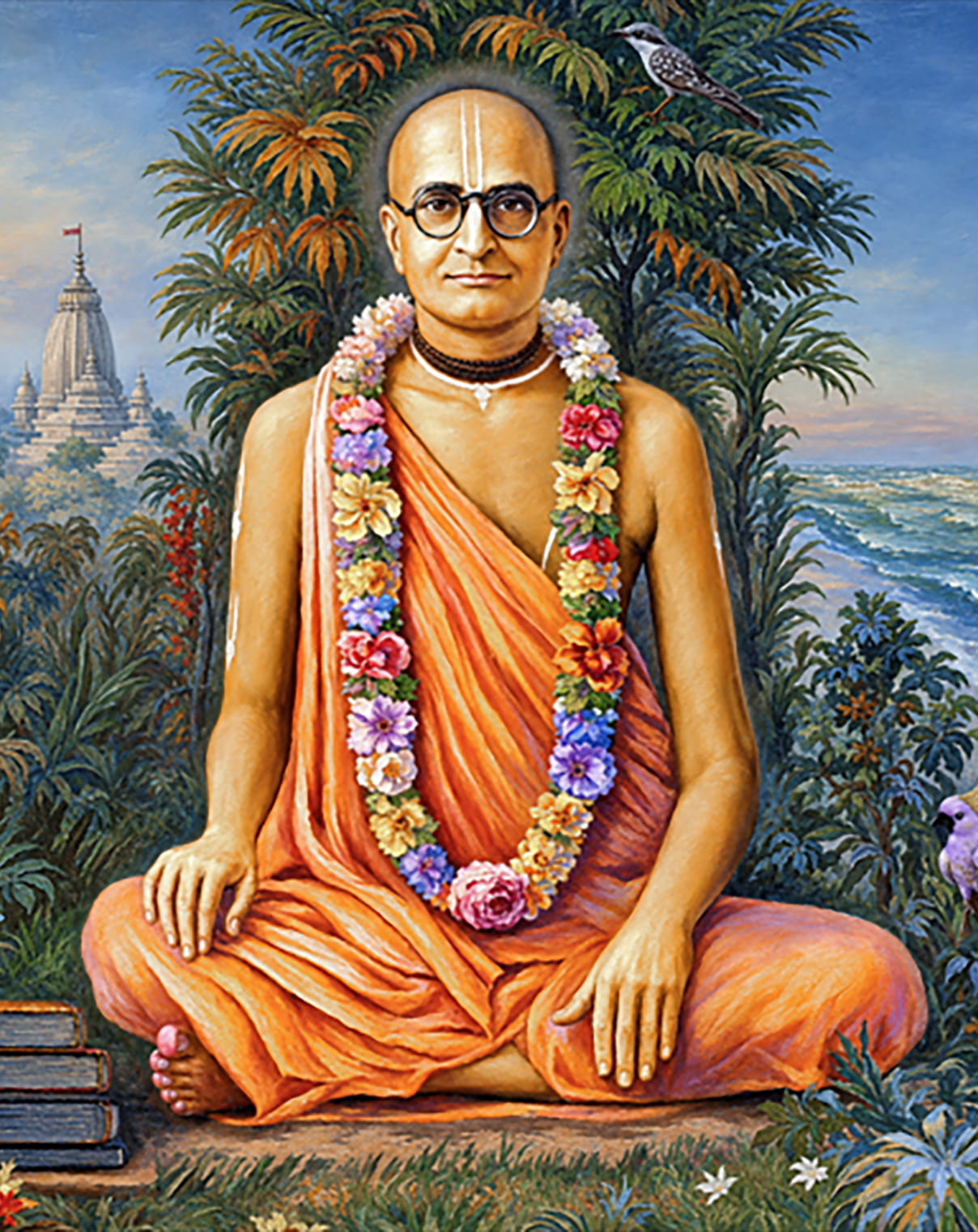
Son of Bhaktivinoda Thakura and spiritual master of Srila Prabhupada, who founded the Gaudiya Math, opened 64 temples, and first sent preachers to the West.

Biography
Introduction
Śrīla Bhaktisiddhānta Sarasvatī Ṭhākura was the spiritual master of His Divine Grace A. C. Bhaktivedanta Swami Prabhupāda and the most powerful preacher of Lord Caitanya's teachings in the early twentieth century. Son of Śrīla Bhaktivinoda Ṭhākura and disciple of Śrīla Gaura Kiśora Dāsa Bābājī Mahārāja, he took the pure teachings his father had revived and spread them across India and beyond, founding the Gauḍīya Maṭh, establishing sixty-four temples, and sending the first Gauḍīya preachers to the West.
He was uncompromising in philosophy and fearless in preaching, and was known as the siṁha-guru, the lion guru. He fought caste-ism, sahajiyā imitation and impersonalism, and showed that a Vaiṣṇava is to be honoured for his devotion rather than his birth. Above all, he insisted that the sole duty of a devotee is to spread service to the Lord and His devotees.
Appearance in Jagannātha Purī
Bimala Prasāda Datta, later known as Śrīla Bhaktisiddhānta Sarasvatī Ṭhākura, appeared at 3:30 in the afternoon on 6 February 1874, the fifth day of the dark fortnight of the month of Govinda, in Jagannātha Purī, close to the temple of Lord Jagannātha. He was the fourth son of Śrīla Bhaktivinoda Ṭhākura and Śrīmatī Bhagavatī Devī, and appeared as the answer to his father's prayer for a "ray of Viṣṇu" to help spread Lord Caitanya's mission.
He was born with his umbilical cord wrapped around his body like a brāhmaṇa's sacred thread, and an astrologer found in his chart all thirty-two marks of a mahāpuruṣa, predicting that the child would become world-famous as a teacher of life's ultimate goal. When he was six months old, Lord Jagannātha's Ratha-yātrā cart stopped before his father's house for three days. As his mother held him before the Lord, a garland fell from Lord Jagannātha's neck and encircled the child. His first grains were Jagannātha prasāda, and when his inclination was tested he embraced the Śrīmad-Bhāgavatam, foreshadowing his life as a preacher.
Childhood and Education
Bimala Prasāda grew up in Bengal hearing about Kṛṣṇa from his parents. When he was seven, a Deity of Lord Kūrma was unearthed during the construction of Bhakti Bhavan, the family home in Calcutta. Bhaktivinoda Ṭhākura gave the Deity to his son, who worshipped Him daily from then on. By the same age he had memorised the entire Bhagavad-gītā and could explain its verses. His father also gave him the Hare Kṛṣṇa mahā-mantra and a Nṛsiṁha mantra, which he chanted faithfully throughout his life.
He had a remarkable memory and could recall perfectly whatever he read once. Trained in printing and proof-reading at his father's press, he helped produce the journal Sajjana-toṣaṇī. He studied mathematics and astronomy with such brilliance that his tutors awarded him the title Siddhānta Sarasvatī. At the request of Śrīla Jagannātha Dāsa Bābājī Mahārāja he compiled the Navadvīpa Pañjikā, a Vaiṣṇava calendar listing the appearance and disappearance days of the associates of Lord Caitanya.
In 1892 he entered Sanskrit College in Calcutta, but left in 1895 to devote himself fully to devotional service, saying that he had studied for the service of Śrī Caitanya, not for the cultivation of grammar. From 1895 to 1905 he served the royal family of Tripura in various posts. Throughout this time he lived as a strict celibate. From 1897 he observed the vows of Cāturmāsya strictly, cooking for himself only once a day, eating from the ground and sleeping on the bare earth.
Initiation by Śrīla Gaura Kiśora Dāsa Bābājī
Many so-called gurus wanted to make the brilliant son of a magistrate their disciple, but Siddhānta Sarasvatī was not interested in them. When Śrīla Gaura Kiśora Dāsa Bābājī Mahārāja, the renounced paramahaṁsa who came to hear Bhaktivinoda Ṭhākura's discourses at Godruma, saw him, he gave the young man his own chanting ropes, tilaka stamp and articles of worship. Siddhānta Sarasvatī was attracted to the Bābājī's lotus feet at first sight.
On his father's urging he asked for initiation in the month of Māgha, 1900. The Bābājī, reluctant to accept such a great scholar, tested him three times. First he said he would ask Mahāprabhu. Next he said he had forgotten to ask. Finally he said that Mahāprabhu had not given permission. Heartbroken, Siddhānta Sarasvatī declared that without his guru's mercy he could not go on living, and he began to weep. His determination melted the Bābājī's heart. He told him to bathe in the Sarasvatī River and then initiated him, giving the name Śrī Vārṣabhānavī-devī-dayita Dāsa, servant of the beloved of Śrīmatī Rādhārāṇī. The episode recalls Lokanātha Gosvāmī's acceptance of Narottama Dāsa Ṭhākura as his only disciple.
A Billion Names at Māyāpur
In 1898 he toured Benares, Prayāga and Gayā with his father, and in 1904 and 1905 he travelled through South India, visiting Tirupati, Śrī Raṅgam and other holy places and studying the traditions of the other Vaiṣṇava sampradāyas. He also published biographies of Vaiṣṇava saints in Sajjana-toṣaṇī.
In 1905, at the age of thirty-one and on his father's instruction, he began a great vow at the Yogapīṭha, the birthplace of Lord Caitanya in Māyāpur. Following Nāmācārya Haridāsa Ṭhākura, he chanted three hundred thousand names daily, completing one billion names in about nine years. He lived first in a grass hut and, from 1909, in a cottage at Vrajapattana. During this period, in 1906, he initiated his first disciple. In 1913 he set up the Bhāgavat Press in Calcutta, the first of his many printing presses.
Defender of Vaiṣṇava Siddhānta
In 1911 a great controversy arose in Bengal. Caste gosvāmīs and smārta brāhmaṇas claimed that a person born outside a brāhmaṇa family could never worship the śālagrāma-śilā or become an ācārya, even after Vaiṣṇava initiation. A conference was called in the Midnapore District. Bhaktivinoda Ṭhākura, bedridden with illness, lamented that there was no one to answer them. In response his son wrote the essay Brāhmaṇa o Vaiṣṇava, comparing brāhmaṇas and Vaiṣṇavas. On hearing it the Ṭhākura sat up in joy and called him "truly Sarasvatī".
At the three-day conference, Siddhānta Sarasvatī first recited the scriptural glories of the brāhmaṇas, delighting his opponents, and then explained who a brāhmaṇa truly is, who a Vaiṣṇava is, and what qualifies a guru. On the final day he spoke for two hours, and no one could answer him. Thousands rushed forward to take the dust of his feet. He refused to let anyone touch his feet and always returned obeisances to anyone who offered them. Later that same year he defeated those who claimed that the name Gaura in the Gaura-gāyatrī was not eternal and that Lord Caitanya was not God.
Departure of His Gurus
On 23 June 1914 Śrīla Bhaktivinoda Ṭhākura entered the eternal pastimes of the Lord at Bhakti Bhavan in Calcutta. On 17 November 1915, Utthāna Ekādaśī, Śrīla Gaura Kiśora Dāsa Bābājī Mahārāja departed at Kuliya, Navadvīpa. The heads of local temples quarrelled over where to place his body, hoping to profit from the pilgrims who would visit his samādhi. Siddhānta Sarasvatī silenced them by declaring that only a renunciate who had kept himself free from illicit association even for the last few days could touch the body. One by one they left, and he placed his guru in samādhi himself.
Sannyāsa and the Gauḍīya Maṭh
Until 1918 he was absorbed mainly in chanting and publishing. Then, at the urging of his disciples, he resolved to preach on a large scale. On the full-moon day of Phālguna, 29 March 1918, at Vrajapattana in Māyāpur, he accepted sannyāsa and the name Śrī Bhaktisiddhānta Sarasvatī Gosvāmī. In November that year the Śrī Bhaktivinoda Āsana was opened at No. 1 Ultadanga Junction Road in Calcutta. In 1920 it became the Gauḍīya Maṭh, the centre of a mission that grew rapidly across India.
In 1919 he re-established the Viśva-vaiṣṇava-rāja-sabhā and installed the Deity of Śrīla Bhaktivinoda Ṭhākura at Svānanda-sukhada-kuñja in Godruma. Work began in 1923 on the twenty-nine-pinnacled Śrī Caitanya Maṭh in Māyāpur. Over the next decade he founded temples in Navadvīpa-maṇḍala, throughout Bengal, in Purī, Vṛndāvana, Mathurā, Delhi, Madras and other cities, and abroad in Rangoon, London and Germany, sixty-four in all.
Preaching through Print and Pilgrimage
Bhaktisiddhānta Sarasvatī considered the printing press the great mṛdaṅga, which carries the holy name much further than a drum. He established the Bhāgavat Press (1913), the Gauḍīya Printing Works (1923), the Nadia Prakash Printing Press in Māyāpur (1928) and the Paramarthi Printing Works in Cuttack (1936). He published the weekly Gauḍīya from 1922 and the Nadia Prakash, which became a daily newspaper. He also published The Harmonist in English and magazines in Hindi, Oriya and Assamese. When asked how a spiritual daily was possible, he answered that the glories of the Lord could fill a newspaper every second.
He personally wrote more than 108 essays and books, including the Gauḍīya Bhāṣya on Caitanya-bhāgavata and the Anubhāṣya on Caitanya-caritāmṛta. He printed the Śrīmad-Bhāgavatam with word-for-word meanings and the works of Madhvācārya and Rāmānujācārya. He organised large diorama exhibitions in Māyāpur, Calcutta, Dacca, Kurukṣetra, Benares and Allahabad. He also revived the annual parikramā of Navadvīpa-dhāma and led thousands on the circumambulation of Vraja-maṇḍala. He identified and marked places sanctified by Lord Caitanya, including the site at Prayāga where the Lord taught Śrīla Rūpa Gosvāmī.
Meeting Śrīla Prabhupāda
In 1922, at the Gauḍīya Maṭh in Calcutta, he met a young chemist named Abhay Charan De, who would become His Divine Grace A. C. Bhaktivedanta Swami Prabhupāda. At their very first meeting he asked the young man to preach Lord Caitanya's message in the English language. Śrīla Prabhupāda later recalled that he did not take up the order fully until 1958. When he did, it became the founding mission of the International Society for Krishna Consciousness, through which Bhaktisiddhānta Sarasvatī's desire to spread the holy name throughout the world was fulfilled.
Sending the Message to the West
After the Gaura Pūrṇimā festival of 1933 he resolved to send preachers to Europe, in line with the desires of Lord Caitanya and Bhaktivinoda Ṭhākura. On 18 March in Madras he gave farewell instructions to Bhakti Pradīp Tīrtha Mahārāja, Bhakti Hṛdaya Bon Mahārāja and Sambidānanda Prabhu. These were later published as the essay L'Envoi. In them he explained that a preacher attracts others by living the instruction to be humbler than a blade of grass, more tolerant than a tree, free from the desire for honour, and ready to honour everyone.
In May 1933 a preaching centre opened in Kensington, London. His preachers corresponded with Lord Zetland and other dignitaries, met King George V and Queen Mary at Buckingham Palace, and spoke with the Archbishop of Canterbury. By the end of the year they had lectured in Germany and France, and from 1934 they spoke at German universities, where interest in Sanskrit and Vedic culture was strong.
Final Days and Departure
In October 1936 he went to Jagannātha Purī and there showed signs of illness. At Caṭaka-parvata, which is non-different from Govardhana Hill, he held festivals for Śrī Madhvācārya and for his own guru. He was often heard reciting the prayers of Śrīla Rūpa Gosvāmī and Śrīla Raghunātha Dāsa Gosvāmī, begging Govardhana for a dwelling place near His side. He told his disciples to take up sincere hari-bhajana, for not many days remained, and on 6 December he returned to Calcutta.
On the morning of 31 December 1936 he asked for Narottama Dāsa Ṭhākura's song Śrī Rūpa Mañjarī and the Śikṣāṣṭaka to be sung. He had already asked his disciples to form a governing body of ten or twelve devotees to manage the mission. Among his last words were that Ṭhākura Narottama lived on the principles of Rūpa and Raghunātha, and that it is good to follow that path. He blessed all his followers, present and absent, and reminded them that their sole duty and religion was to spread service to the Lord and His devotees. At about 5:30 in the morning on Thursday, 1 January 1937, he left this world uttering the name of Kṛṣṇa.
His body was carried in a vast kīrtana procession from Calcutta to Śrīdhāma Māyāpur. There it was taken to the Yogapīṭha, Śrīvāsa-aṅgana and Advaita Bhavana before reaching Vrajapattana, where he had chanted his billion names. After a night of kīrtana, he was placed in samādhi according to the rites of Śrīla Gopāla Bhaṭṭa Gosvāmī's Saṁskāra-dīpikā, while devotees sang his favourite songs.
His Legacy
Śrīla Prabhupāda described his spiritual master as a "Vaikuṇṭha man" and especially praised his preaching against caste-ism, sahajiyā practices and impersonalism. He united Vaiṣṇavas by stressing what the four sampradāyas share and published the works and biographies of their ācāryas. He organised the Gauḍīya mission with sannyāsīs, temples, presses and a governing body. He also adopted modern means such as motor cars, printing and exhibitions in the Lord's service, setting the pattern Śrīla Prabhupāda later followed worldwide.
Most of all, his order to preach in English, given in 1922 to a young man in Calcutta, became the seed of the worldwide Hare Kṛṣṇa movement. Every devotee who chants the holy name today is indebted to Śrīla Bhaktisiddhānta Sarasvatī Ṭhākura.
Teachings
Introduction
Śrīla Bhaktisiddhānta Sarasvatī Ṭhākura did not set out to teach anything new. His mission was to present the original teachings of Śrī Caitanya Mahāprabhu and the Six Gosvāmīs without addition or compromise, and to carry them to every corner of the world. His disciples called him gaura-vāṇī-śrī-mūrti, the personified teachings of Lord Caitanya. The principles below are drawn from his preaching, his writings, and his own example, as remembered by his disciple Śrīla Prabhupāda.
1. Our Sole Duty Is to Spread the Holy Name
Among his last words to his disciples was the instruction that their sole duty and religion was to spread service to the Lord and His devotees. For Bhaktisiddhānta Sarasvatī, devotional service was not a private affair. A Vaiṣṇava is para-duḥkha-duḥkhī, one who is pained by the suffering of others, and the greatest welfare work is to give the holy name to people who have forgotten Kṛṣṇa.
This conviction shaped his whole mission: temples in busy cities, preaching parties, exhibitions, magazines in many languages, and finally preachers sent to Europe. Śrīla Prabhupāda recalled that his guru did not like to open a centre where few people lived, because devotees are meant not to live peacefully in seclusion but to recruit Kṛṣṇa's eternal servants.
2. The Printing Press Is the Bṛhat Mṛdaṅga
When he founded the Bhāgavat Press in 1913, he called it the bṛhat mṛdaṅga, the great drum. An ordinary kīrtana can be heard only a few streets away, but a printed book carries the holy name and the conclusions of the Gosvāmīs far and wide, across countries and generations.
For this reason he made publishing the heart of his mission. He printed the Śrīmad-Bhāgavatam, Caitanya-caritāmṛta and the works of the Gosvāmīs and other ācāryas, and he ran presses and journals in several languages. Śrīla Prabhupāda took this instruction to heart, and book distribution became the backbone of ISKCON.
3. Preaching Is Better than Imitative Solitary Bhajana
Bhaktisiddhānta Sarasvatī strongly criticised nirjana-bhajana, chanting in seclusion by those who are not yet qualified for it. In his song beginning duṣṭa mana! tumi kisera vaiṣṇava, he rebukes the mind for chanting in a solitary place merely to gain a reputation for renunciation, calling such chanting cheating.
The real Vaiṣṇava does not desire material profit, fame or adoration. He thinks only of how to benefit suffering humanity. Chanting in the association of devotees and engaging in preaching purifies the heart far more than an artificial show of advanced bhajana. He himself chanted a billion names in Māyāpur, but he did so to prepare for a lifetime of preaching, not to withdraw from the world.
4. A Vaiṣṇava Is Judged by Devotion, Not by Birth
Bhaktisiddhānta Sarasvatī's best-known battle was against caste-ism. Following Lord Caitanya's statement kibā vipra, kibā nyāsī, śūdra kene naya, yei kṛṣṇa-tattva-vettā, sei 'guru' haya, he taught that whoever knows the science of Kṛṣṇa is fit to be a guru, whatever family he was born in. At the Midnapore conference of 1911 he proved from scripture that a properly initiated Vaiṣṇava is fully qualified to worship the śālagrāma-śilā and to act as an ācārya.
Śrīla Prabhupāda said this was his guru's great contribution: he defeated the caste gosvāmīs and their hereditary claims, just as Lord Caitanya had done. His opponents were so angered that they once tried to bribe a police officer so that they could harm him, but even the officer refused to act against a sādhu.
5. Daiva-varṇāśrama: Position by Qualification
He spoke widely on daiva-varṇāśrama, the divine social order described in the Bhagavad-gītā, in which a person's place is decided by his qualities and work rather than by his birth. Brāhmaṇas, sannyāsīs and teachers should be recognised by their character, knowledge and devotion. He applied this principle in the Gauḍīya Maṭh by giving brāhmaṇa initiation and sannyāsa to qualified devotees from any background, and he revived the Vedic tridaṇḍi sannyāsa order for Vaiṣṇava preachers.
6. Lord Caitanya Is the Supreme Lord
He firmly established that Śrī Caitanya Mahāprabhu is Kṛṣṇa Himself, and that His name, form, qualities and pastimes are eternal. When scholars claimed in 1911 that the name Gaura in the Gaura-gāyatrī was not eternal, he cited the Caitanya Upaniṣad, the Śvetāśvatara Upaniṣad, the Purāṇas and the Śrīmad-Bhāgavatam to prove them wrong. Largely because of his preaching, the Deity of Lord Caitanya is now worshipped throughout India, and the Gaura mantra is received by devotees everywhere.
7. Follow Śrī Rūpa and Śrī Raghunātha
Bhaktisiddhānta Sarasvatī called himself a rūpānuga, a follower of Śrīla Rūpa Gosvāmī. He taught that Śrīla Sanātana, Rūpa and Raghunātha Dāsa Gosvāmīs are the ācāryas of sambandha (our relationship with Kṛṣṇa), abhidheya (the practice of devotional service) and prayojana (the goal of pure love), respectively, and that their writings contain the complete teachings of Lord Caitanya.
In his last days he said that Ṭhākura Narottama lived on the principles of Rūpa and Raghunātha, and that it is good to follow that path. He would not tolerate any teaching that contradicted the Gosvāmīs, however popular it might be.
8. No Compromise with Philosophical Error
He was known as the siṁha-guru, the lion guru, because he never compromised the truth. He preached against Māyāvāda impersonalism and voidism, which deny the personal form of the Lord. He also opposed sahajiyā groups who imitate the intimate pastimes of Rādhā and Kṛṣṇa while ignoring regulative principles, and false incarnations and so-called yogīs who mislead the public.
Some of his own Godbrothers complained that his strong, "chopping" style of preaching would fail. He answered by example, and Śrīla Prabhupāda observed that it was those critics who fell away. In his view, truth spoken without compromise is the greatest kindness, because it saves people from being cheated.
9. The Unity of the Four Vaiṣṇava Sampradāyas
Although uncompromising in philosophy, he was a unifier of Vaiṣṇavas. He taught that the four authorised sampradāyas, those of Madhvācārya, Rāmānujācārya, Viṣṇusvāmī and Nimbārkācārya, all agree that the Lord is the Supreme Eternal Person, to be served eternally by the living beings, and all refuted Śaṅkarācārya's impersonalism. Lord Caitanya accepted the best conclusions of each ācārya and completed them in His philosophy of acintya-bhedābheda-tattva, inconceivable oneness and difference.
To show this harmony, the Śrī Caitanya Maṭh in Māyāpur honours the four sampradāya ācāryas in alcoves at its four corners. He visited their holy places, studied their worship, and published their writings and biographies.
10. The Qualities of a Preacher
In 1933, sending his first preachers to Europe, he gave them instructions later published as L'Envoi. He reminded them that the highest function of the soul is to chant the glories of Hari while being humbler than a blade of grass, more tolerant than a tree, seeking no honour for oneself and offering honour to all. He said that his own guru had attracted him by living these four principles, and that his disciples could attract the whole world only by the same method.
He practised this himself. He never allowed anyone to touch his feet, and whenever someone offered him obeisances he immediately offered obeisances in return. He even addressed his disciples as his friends.
11. The Disciple Should Remain a Fool before the Guru
His own initiation showed the determination needed to receive a pure devotee's mercy. Refused three times by Gaura Kiśora Dāsa Bābājī, he declared that he could not live without his guru's mercy. Though a renowned scholar, he always remained a humble servant before his outwardly unlettered guru.
Śrīla Prabhupāda drew from this the lesson that a disciple should remain a fool before the spiritual master, not artificially but sincerely. As soon as a disciple thinks himself wiser than the guru, his progress is lost. In the absolute realm the master and the fool reciprocate in love.
12. Devotion Is the Key to Scripture
He taught that the śāstras cannot be understood by scholarship alone. As Śrīla Prabhupāda remembered him saying, for one who is not engaged in devotional service, reading all the books is like licking the outside of a honey jar. The sweetness is inside, and only service to Kṛṣṇa opens the jar. Practical devotion under a bona fide guru is therefore the real secret of understanding the scriptures.
13. Strict Sādhana and Firm Vows
As a small boy, he once took a mango before it had been offered to the Deity. When his father pointed this out, he vowed never to eat mangoes again, and he kept that vow for the rest of his life. He lived as a strict brahmacārī from childhood, observed Cāturmāsya by eating from the ground and sleeping on the bare earth, and chanted three hundred thousand names daily for nine years.
By this example he taught that everything should first be offered to the Lord, and that a devotee's resolve must be unshakeable. Śrīla Prabhupāda said this is the characteristic of the ācārya: he teaches by his own actions.
14. Engage Everything in Kṛṣṇa's Service
Bhaktisiddhānta Sarasvatī did not reject the modern world. He used it for Kṛṣṇa. Presses, newspapers, motor cars, railways, dioramas and large public exhibitions all became instruments of preaching in his hands. This is yukta-vairāgya, practical renunciation, as taught by Śrīla Rūpa Gosvāmī: renunciation means not giving up things but using everything in the Lord's service, without personal attachment. Śrīla Prabhupāda followed the same principle worldwide.
15. Cooperate for the Mission
Foreseeing the needs of the mission after his departure, he asked his disciples to form a governing body of ten or twelve devotees to manage its affairs together. One of his final statements was that "love and rupture both should have the same end in view": whether in agreement or disagreement, devotees must keep the service of the Lord as their single aim. Śrīla Prabhupāda later carried this instruction forward by forming the Governing Body Commission of ISKCON.
Qualities
Introduction
Śrīla Prabhupāda said that the ācārya teaches by his own actions. Śrīla Bhaktisiddhānta Sarasvatī Ṭhākura's life shows the qualities of a pure Vaiṣṇava in a striking combination: he was a lion in defending the truth and humbler than a blade of grass in his personal dealings, a strict renunciate and a tireless organiser. The qualities below are drawn from incidents in his life.
1. Fearlessness in Upholding the Truth
He was called the siṁha-guru, the lion guru, because he never compromised the teachings of Lord Caitanya. He stood alone against the caste gosvāmīs and smārtas, against sahajiyā groups and against impersonalists, even when it made him powerful enemies. His opponents once tried to bribe a police officer so that they could harm him. The officer refused and warned him, but he never softened his preaching.
Śrīla Prabhupāda recalled that so-called saints, avatāras and yogīs who were false were all enemies of his guru, because he never compromised.
2. Deep Humility
The same lion was personally the humblest of servants. He did not allow anyone to touch his feet, and whenever someone offered him obeisances he returned them at once. At the 1911 Midnapore conference, when the guards forcibly washed his feet to give the water to the crowd, he protested strongly. He addressed his disciples as his friends, and though a great scholar he remained a humble servant before his guru, who outwardly could not even read.
3. Unwavering Dedication to His Guru
When Gaura Kiśora Dāsa Bābājī refused three times to initiate him, he did not give up. He declared that he could not live without his guru's mercy, and his tears finally won it. He served his guru faithfully, and at the Bābājī's departure he alone stood up to those who wanted his body for profit, and placed him in samādhi himself.
Gaura Kiśora Dāsa Bābājī, who never allowed anyone to touch his feet, placed them on his disciple's head and called him "my Prabhu", saying he saw the renunciation of Śrī Rūpa and Śrī Raghunātha manifest in him.
4. Renunciation and Austerity
He lived as a strict brahmacārī from childhood. During Cāturmāsya he cooked one simple preparation, ate it from the floor and slept on the bare ground without a pillow. For nine years he chanted three hundred thousand names a day in a grass hut and then a simple cottage at Māyāpur. When the roof leaked, he held an umbrella and went on chanting rather than lose time repairing it. He accepted a pension from the Tripura royal family for some time and then gave it up.
5. Determination in Keeping Vows
As a small boy he ate a mango before it had been offered to the Lord. When his father corrected him, he vowed never to eat mangoes again and kept that vow all his life, even when his disciples later offered him mangoes. He completed his vow of a billion names in spite of travel and difficulties. His resolve, once taken, was never broken.
6. Scholarship and Brilliance
He had an extraordinary memory and could recall anything he had read once. By seven he knew the Bhagavad-gītā by heart, and his tutors gave him the title Siddhānta Sarasvatī for his mastery of astronomy and mathematics. He compiled the Vaiṣṇava-mañjuṣā encyclopedia, wrote over 108 books and essays, and once gave thirty interpretations of a single Vedānta-sūtra verse. Śrīla Prabhupāda said he was called a "living encyclopedia", able to speak with anyone on any subject.
Yet he valued learning only in Kṛṣṇa's service. He left Sanskrit College because he had studied for the service of Śrī Caitanya, not for the cultivation of grammar.
7. Compassion for Suffering Souls
Śrīla Prabhupāda described his guru as para-duḥkha-duḥkhī, one who is pained by others' suffering, and as a "cent per cent Vaiṣṇava". His sharp preaching came from compassion: he wanted to save people from being cheated by false teachers. When one of his sannyāsī disciples was dragged back to family life, he wept, lamenting that he could not save that soul.
8. Tireless Preaching Spirit
He did not want to live peacefully in seclusion. He opened centres in populated cities, led thousands on parikramā, held exhibitions across India, and lectured, wrote and debated wherever he went. In twenty years he established sixty-four temples and sent preachers to Europe. Even in his final illness at Purī he lectured for a month and a half, urging his disciples to take up sincere hari-bhajana.
9. Vision and Organisational Genius
He built a worldwide mission from almost nothing. He organised sannyāsīs, brahmacārīs and householders into an active preaching society, set up printing presses and magazines in several languages, and even launched a daily newspaper. Foreseeing the future, he asked his disciples to form a governing body to manage the mission after him. Śrīla Prabhupāda later adopted this model in ISKCON.
10. Respect for All Vaiṣṇava Traditions
Though firm in Gauḍīya siddhānta, he honoured the four Vaiṣṇava sampradāyas. He visited their holy places, studied their worship, published the works and lives of Madhvācārya and Rāmānujācārya, and gave their ācāryas places of honour on the Śrī Caitanya Maṭh in Māyāpur. He sought to unite the Vaiṣṇava world on the common ground of service to the Supreme Person.
11. Practical Use of Everything for Kṛṣṇa
He did not reject modern means but used them for preaching: the printing press, which he called the bṛhat mṛdaṅga, along with newspapers, motor cars and railway travel, and dioramas and public exhibitions. In this he embodied yukta-vairāgya, renunciation by engaging everything in the Lord's service without personal attachment.
12. Absorption in Rādhā-Kṛṣṇa and the Holy Name
Behind all his outer activity was deep inner absorption. His initiated name, Vārṣabhānavī-devī-dayita Dāsa, means servant of the one dear to Śrīmatī Rādhārāṇī. In his last days at Purī he constantly recited the prayers of Śrīla Rūpa and Raghunātha Gosvāmīs to Govardhana, and before departing he asked to hear Śrī Rūpa Mañjarī and the Śikṣāṣṭaka. He left this world chanting the name of Kṛṣṇa.
Summary
Fearlessness, humility, dedication to guru, renunciation, determination, scholarship, compassion, preaching zeal, vision, respect for other Vaiṣṇavas, practical renunciation, and deep absorption in Kṛṣṇa are the qualities that made Śrīla Bhaktisiddhānta Sarasvatī Ṭhākura the ācārya who prepared the way for the worldwide Hare Kṛṣṇa movement.
Timeline
- 1874
6 February 1874
Appearance
Jagannatha Puri
Born to Bhaktivinoda Thakura and Bhagavati Devi.
- 1892
Enters Sanskrit College
Calcutta
Began college at eighteen; left in 1895.
- 1900
Magha, 1900
Initiation
Godruma, Navadvip
Initiated by Gaura Kishora Dasa Babaji.
- 1905
Begins vow of chanting a billion names
Yogapitha, Mayapur
Followed Haridasa Thakura's example.
- 1911
Brahmana and Vaishnava debate
Midnapore
Established the position of a Vaishnava above caste brahmanas.
- 1918
29 March 1918
Accepts sannyasa
Mayapur
Took the name Bhaktisiddhanta Sarasvati Gosvami.
- 1920
Gaudiya Math established
Calcutta
The Bhaktivinoda Asana was renamed the Gaudiya Math.
- 1922
Meets Srila Prabhupada
Calcutta
Asked him to preach Lord Chaitanya's message in English.
- 1933
Sends preachers to the West
London; Germany
Gaudiya preachers lectured in England and Germany.
- 1937
1 January 1937
Disappearance
Calcutta
Departed after establishing 64 temples.
Lineage
Gurus and predecessors
- Guru
Srila Gaura Kishora Dasa Babaji Maharaja
Paramahamsa babaji and spiritual master of Bhaktisiddhanta Sarasvati Thakura
1830s – 17 November 1915 (Utthana Ekadashi)
Disciples and successors
- Disciple
A. C. Bhaktivedanta Swami Prabhupada
Founder-Acharya of ISKCON
September 1, 1896 – November 14, 1977
Books
Gaudiya Bhashya on Chaitanya-bhagavata
Commentary on Vrindavana Dasa Thakura's biography of Lord Chaitanya.
Anubhashya on Chaitanya-charitamrita
Commentary on Sri Chaitanya-charitamrita.
Achar and Acharya
1921On the conduct and qualifications of a true acharya.
The Gaudiya (magazine)
1922Weekly journal of the Gaudiya Math.
Nadia Prakash
1926Magazine that became a daily newspaper.
The Vedanta: Its Morphology and Ontology
1933Lecture later reprinted in Back to Godhead magazine.
The acharyas
All acharyasMore acharyas
Continue along the disciplic succession.

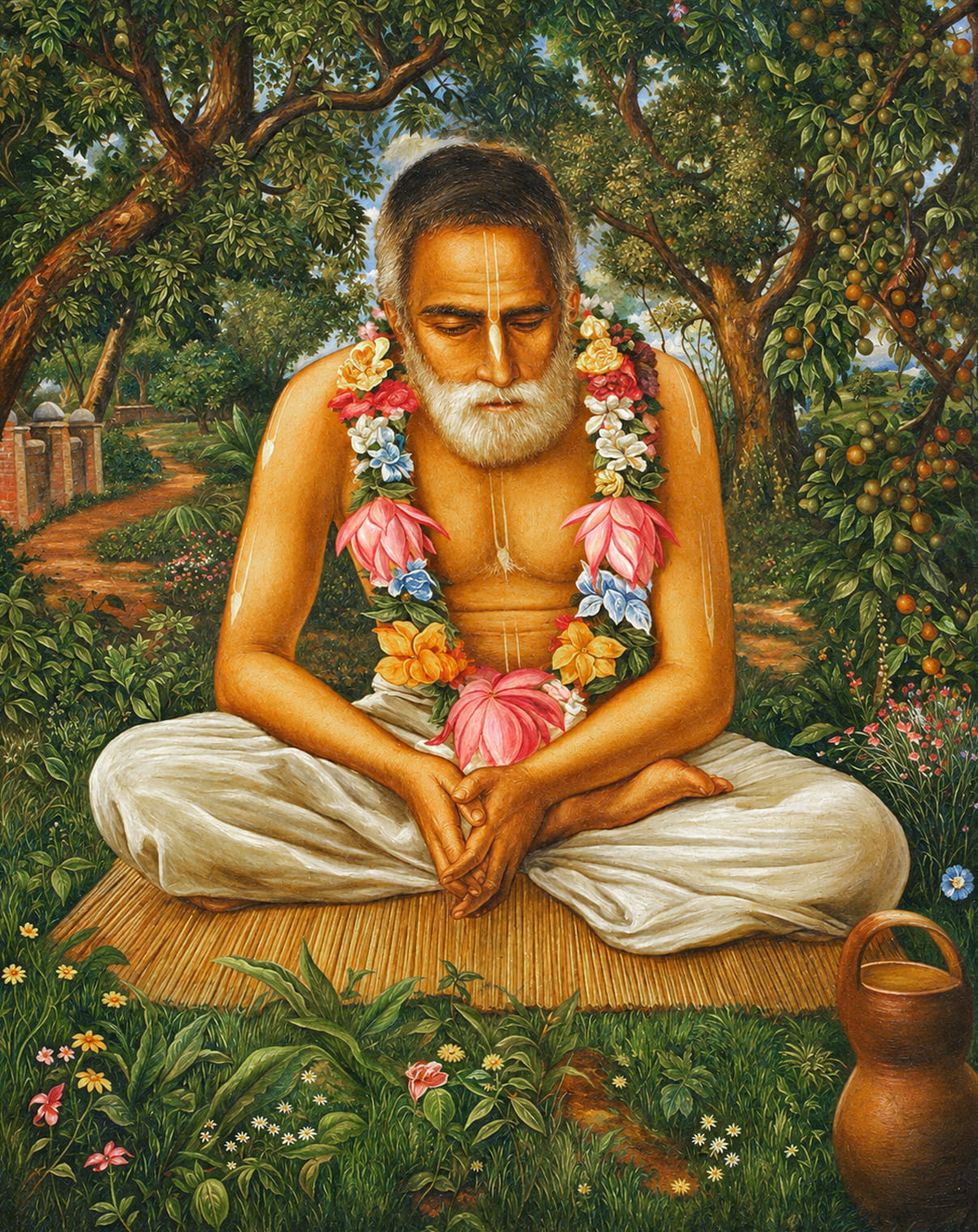
Srila Gaura Kishora Dasa Babaji Maharaja
Paramahamsa babaji and spiritual master of Bhaktisiddhanta Sarasvati Thakura
1830s – 17 November 1915 (Utthana Ekadashi)
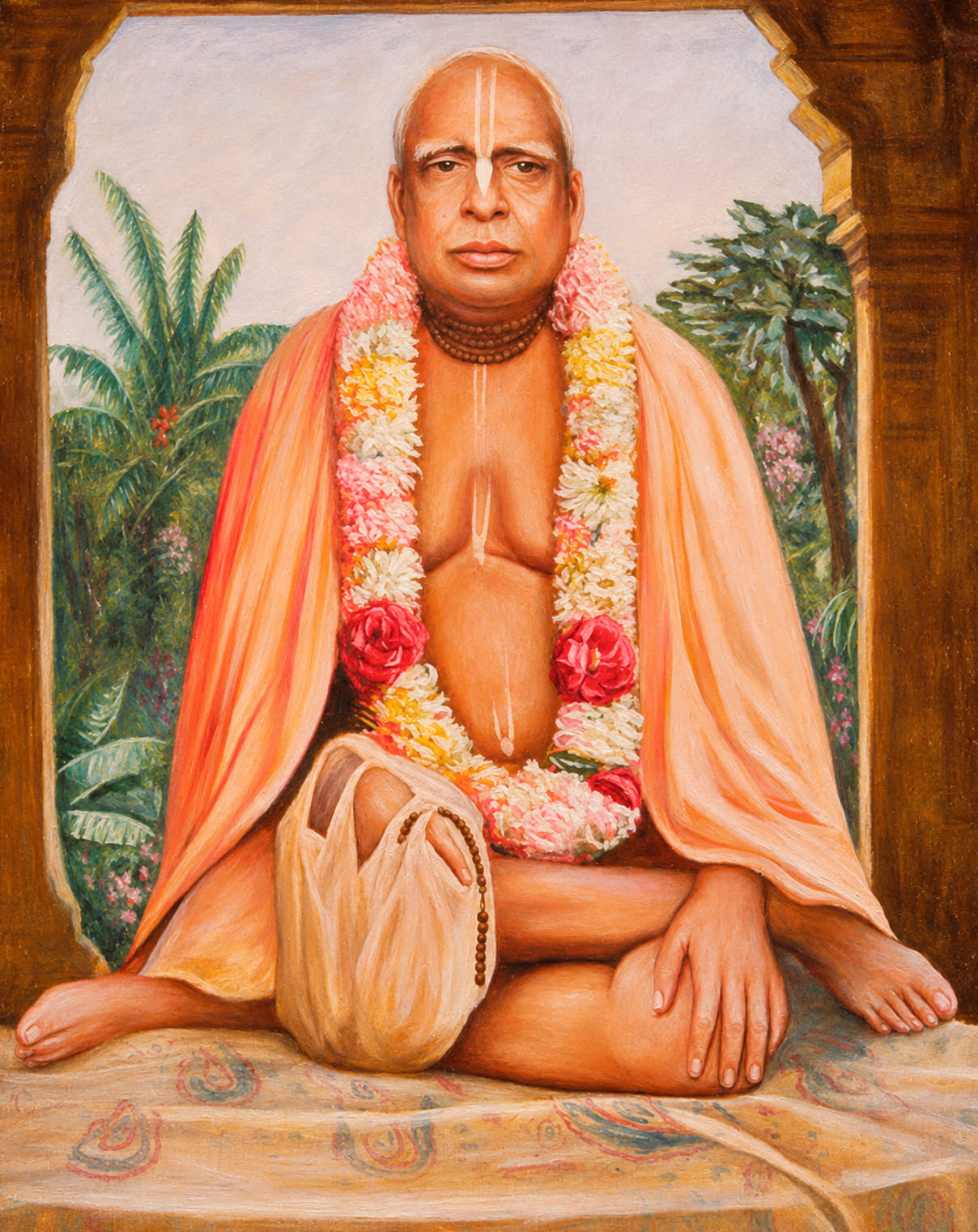
Srila Bhaktivinoda Thakura
The Seventh Goswami, pioneer of the modern Krishna consciousness movement
2 September 1838 – 23 June 1914