
A few days ago, I had an experience that stayed with me deeply.
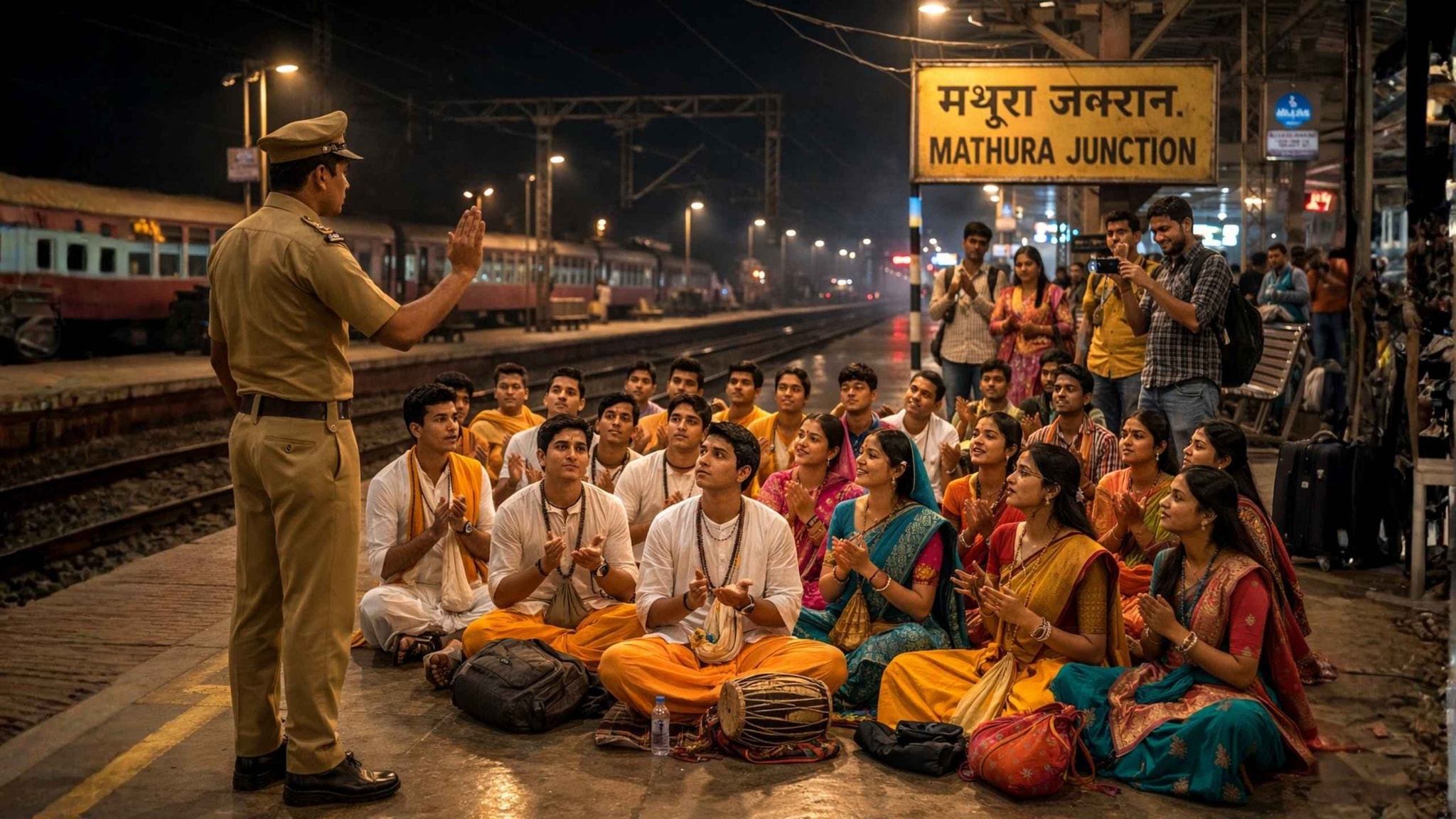
I had just completed a beautiful pilgrimage to Vrindavan with a group of about thirty devotees. After several spiritually uplifting days in the land of Krishna, we were returning home by train.
Our train from Mathura was delayed by almost two hours.
So we sat quietly on the railway platform, waiting.
As devotees often do, someone softly began chanting the Hare Krishna Maha Mantra. Gradually others joined in. It was not loud, not disruptive—just a gentle, melodious kirtan.
Hare Krishna Hare Krishna
Krishna Krishna Hare Hare
Hare Rama Hare Rama
Rama Rama Hare Hare
Within minutes something beautiful began to happen.
Passengers walking by slowed down. Some stood and listened. Some smiled. A few recorded the kirtan on their phones. Children watched curiously. There was a certain joy in the air—something subtle yet tangible.
For about twenty minutes, the platform felt less like a waiting area and more like a sacred gathering.
Then suddenly a police officer approached us.
We immediately stopped and respectfully asked if there was any problem.
He said something that did not upset us—but it did hurt us.
He said: “Yeh shor sharaba band karo.”
Stop this noise.
We had no loudspeakers.
No instruments except mild clapping.
No disturbance.
And yet the kirtan of the holy names of God was called “noise.”
We immediately stopped out of respect for the authorities. There was no argument, no resistance.
But the words lingered in the heart.
When the Sacred Is Mistaken for Noise
The bhajan and kirtan tradition is not a small cultural practice. Today it has become a global spiritual movement.
Across the world—from New York to London, from Melbourne to Moscow—people gather joyfully to chant the Hare Krishna mantra.
Universities host kirtan gatherings.
Yoga studios promote mantra meditation.
Millions of people spend their time and money to experience this spiritual music.
Why?
Because kirtan heals the mind.
It calms anxiety.
It uplifts consciousness.
It creates unity among people.
In a world filled with stress, depression, and loneliness, the chanting of God's holy names brings peace.
And yet, sometimes in the very land where this tradition was born, it is misunderstood.
What Srila Prabhupada Taught the World
The global acceptance of kirtan today is largely due to the efforts of His Divine Grace A. C. Bhaktivedanta Swami Prabhupada.
When he travelled to the West in 1965, people there had never heard the Hare Krishna mantra before.
But when he began chanting in public parks and streets, something remarkable happened.
People felt joy.
They danced.
They sang.
They experienced spiritual happiness.
Within a few years, kirtan spread across the world.
Srila Prabhupada often explained that chanting the holy name is the most powerful spiritual process for this age.
The Srimad Bhagavatam describes this beautifully:
“Kaler dosha-nidhe rajan asti hy eko mahan gunah
Kirtanad eva Krishnasya mukta-sangah param vrajet.”
“In this age of quarrel and hypocrisy, there is one great blessing:
simply by chanting the holy name of Krishna, one can become liberated and attain the supreme destination.”
A Gentle Reflection
This article is not written to criticize the police officer.
He was simply doing his duty according to his understanding.
But the incident raises an important question:
Have we begun to forget the spiritual treasures of our own culture?
India is the land where saints sang the names of God in streets and villages for centuries.
The bhakti saints of India—like Sant Tukaram, Sant Jnaneshwar, Mirabai, Narsinh Mehta & Sri Chaitanya Mahaprabhu (Incarnation of Lord Krishna) —spread devotion through public kirtan.
Five hundred years ago, Sri Chaitanya Mahaprabhu led thousands of people through the streets in sankirtan.
And today the same sacred practice is transforming lives around the world.
Yet sometimes, when it appears gently on a railway platform in India, it is mistaken for disturbance.
What Kirtan Really Is
Kirtan is not noise.
Noise agitates the mind.
Kirtan purifies the mind.
Noise creates disturbance.
Kirtan creates harmony.
Noise divides people.
Kirtan unites people.
This is why wherever kirtan happens—even for a few minutes—the atmosphere changes.
People smile.
Hearts soften.
Joy spreads naturally.
That evening at Mathura station, for twenty minutes, we witnessed exactly that
The Real Message
The incident at the railway platform was small.
But it reminded me of a deeper truth.
Sometimes the world fails to recognize what is truly valuable.
The chanting of the holy name is not merely a ritual.
It is a spiritual technology for inner transformation.
And as Srila Prabhupada repeatedly taught:
“Chant and be happy.”
Perhaps one day, when kirtan arises on a railway platform in India, people will not think of it as “shor sharaba.”
They will recognize it for what it truly is:
a moment when the divine sound of Krishna’s names touches the world.

Comments
Be the first to share your thoughts.