


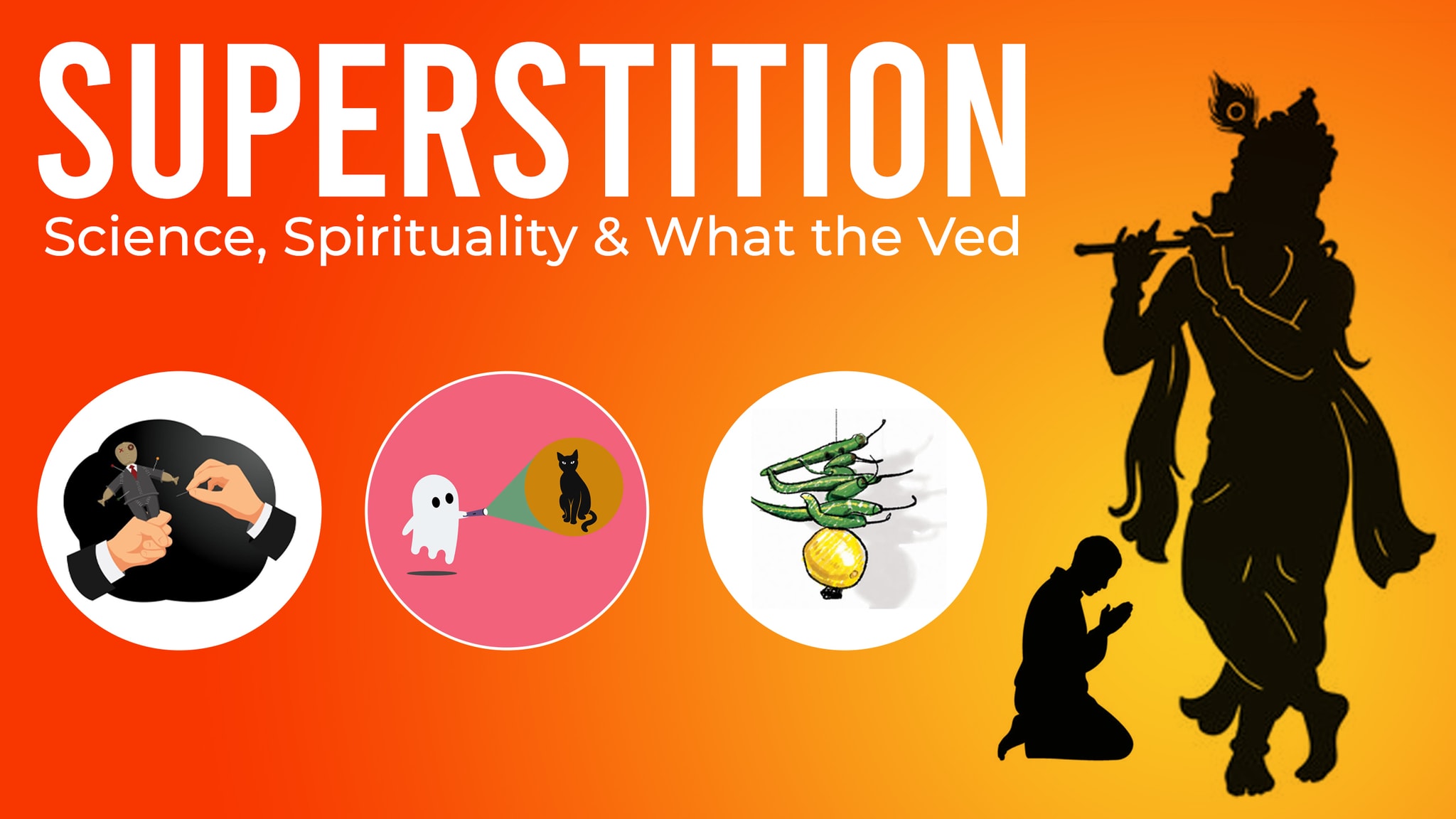
In short
A superstition is a belief followed without knowing its reason. Many Vedic customs, such as not eating during an eclipse, have a basis in shastra (scripture), not in fear. The way to tell them apart is to ask whether a practice comes from authorised scripture and helps one remember God; if it does, it is not superstition.
We’ve all heard them growing up.
“Don’t cut your nails after sunset.”
“Don’t go under a peepal tree at night.”
“Lizards falling on your left shoulder is bad luck.”
Are these just harmless cultural quirks? Or is there some science or spirituality behind them? In a world of artificial intelligence and space tourism, should we still believe in superstition? Let’s explore what the ancient Vedas and the Hare Krishna Movement Ahmedabad have to say.
What Is a Superstition, Really?
A superstition is a belief or practice resulting from ignorance, fear of the unknown, or a trust in magic or chance. But interestingly, many so-called superstitions in India have deep Vedic roots — often practical, sometimes spiritual, and occasionally outdated.
Example 1: Don’t Eat During Eclipses
This isn’t just a grandma myth. According to Ayurveda and Vedic astrology, eclipses disturb the cosmic balance and increase bacterial activity in food. Even today, scientists observe spike in radiation during solar eclipses. Hence, ISKCON temples, including ours, refrain from food consumption during that period.
Example 2: Walking Barefoot on Sacred Ground
In many Krishna temples, devotees walk barefoot. While this seems like ritual, grounding or “earthing” is now proven to reduce inflammation and improve sleep. The Vedas knew it. Now, science is catching up.
Read our blog on Why We Walk Barefoot in the Fields
Are We Justifying Every Belief?
Not at all. Some superstitions are baseless, fear-driven, and need retiring. For example, believing that a sneeze delays travel has no Vedic backing. The Hare Krishna Movement Ahmedabad emphasizes that authentic spirituality is rooted in shastra (scripture), not fear.
Spirituality vs Superstition: Know the Difference
-
Superstition says: “Don’t do it… just because.”
-
Spirituality says: “Understand the why, and then decide.”
In the Bhagavad-gita, Lord Krishna says:
"Those who are not faithful on the path of devotion cannot attain Me."
This implies that faith and fear are not the same. Real faith is guided by knowledge, not blind belief.
Should We Believe in Superstition?
No, but we should respect where the tradition comes from. Instead of blindly accepting or rejecting, we must investigate the roots. Many ISKCON temples promote this balance—honoring tradition while promoting conscious living.
For example, Tulsi worship may look like superstition to some. But Tulsi leaves are rich in antioxidants, purify air, and are deeply connected to Krishna’s pastimes.
Read: The Power of Tulsi Devi
Final Thought: Faith Isn’t Blind When Guided by Knowledge
In a time where science and spirituality are seen as rivals, the Hare Krishna Movement Ahmedabad stands as proof that they can beautifully coexist. It’s not about throwing out every tradition but understanding its purpose.
So next time someone warns you about cutting your nails at night, smile—and maybe ask why.
Looking for a spiritual space that’s rooted in wisdom, not superstition?
Visit harekrishnamandir.org
Explore upcoming festivals, aarti timings, and insightful blogs from your trusted Krishna temple in Ahmedabad.
Frequently asked questions
What is the difference between superstition and a scriptural rule?
A superstition has no authoritative source. A scriptural rule comes from shastra and is meant to purify us and bring us closer to Krishna.
Are all traditional customs scientific?
Some have practical benefits, but the main reason to follow a scriptural rule is that it is given by the Lord and the acharyas, not only because science agrees.
How can I check whether a practice is genuine?
See whether it is supported by guru, sadhu and shastra: the spiritual master, the saints and the scriptures should all agree.
Does following scripture conflict with science?
No. The Vedas describe both material and spiritual knowledge. Science studies matter; the Vedas also explain the soul and God, which matter cannot measure.


Comments
Be the first to share your thoughts.