
In short
This article responds to viral posts claiming that Holi colours harm animals. It argues that compassion should be consistent: we should avoid harmful chemical colours, but we should also recognise the far greater suffering caused by killing animals for food. Devotees celebrate the festival as Gaura Purnima with kirtan, natural colours and prasadam.
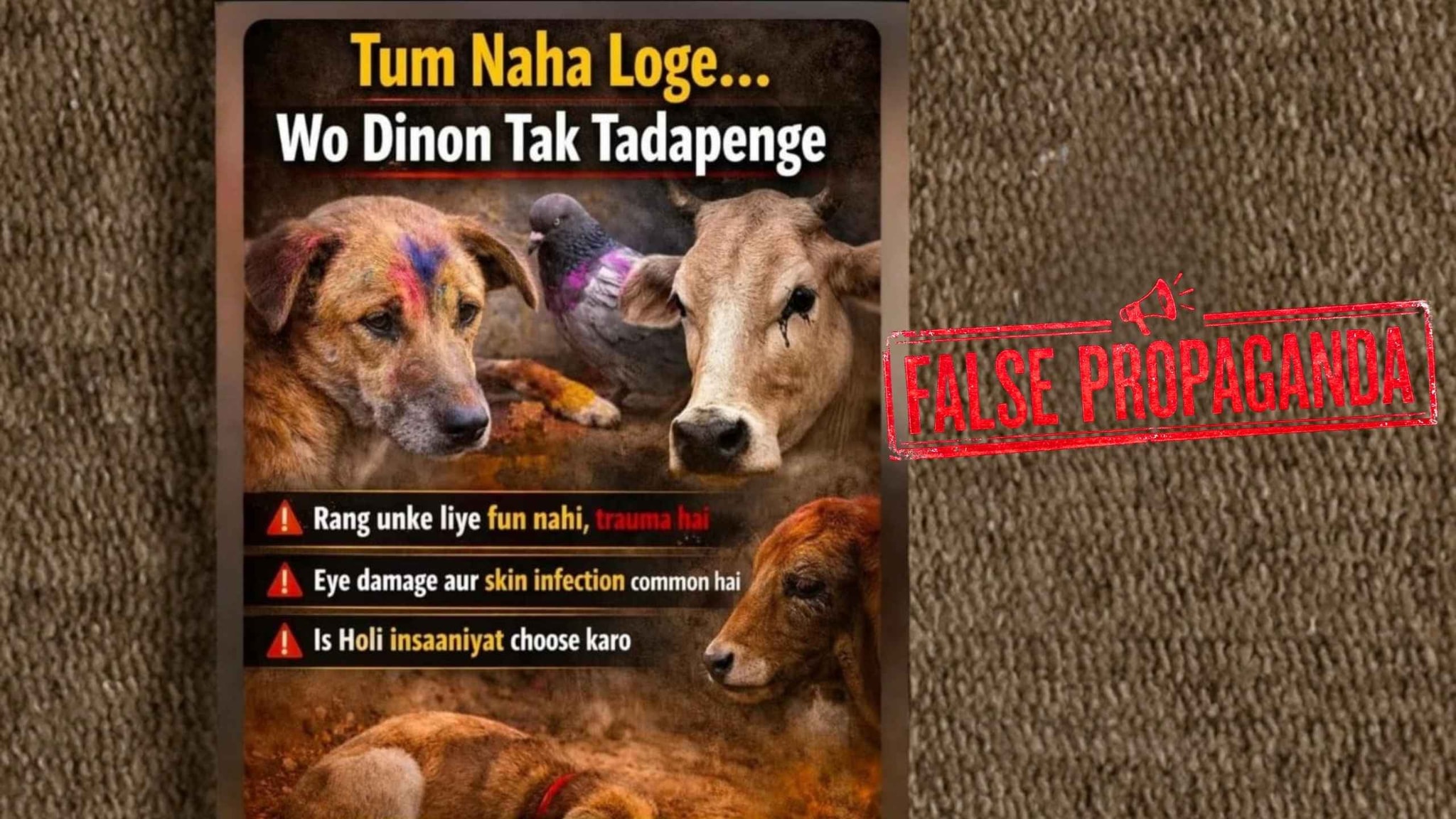
Recently, I noticed a social media status posted by a lady. The image immediately caught my attention. It showed pictures of a dog, a cow, and a bird with colours on their bodies. Along with these images there were alarming captions claiming that colours used during Holi cause trauma to animals, damage their eyes, and harm their skin. The message concluded by suggesting that celebrating Holi in this way is inhuman.
At first glance the message appears emotional and convincing. Anyone who loves animals may feel disturbed after seeing it. But when we pause and think carefully, something feels deeply unfair about the way the festival of Holi is being portrayed.
The image does not simply talk about kindness toward animals. It subtly creates the impression that Holi itself is a cruel festival.
And this is exactly where the problem lies.
Such messages are now circulating widely on social media. Many well-meaning people forward them without questioning the narrative behind them. Slowly and quietly, these posts begin to create a distorted perception about one of India’s most joyful and sacred festivals.
Seeing this made me feel that it is necessary to speak about the issue clearly. Not out of anger, but out of concern that our own people should not unknowingly become victims of misleading propaganda.
Holi does not deserve to be portrayed in this way.
Holi Has Always Been a Festival of Joy
Holi is one of the most joyful festivals of the Indian tradition. It celebrates the victory of devotion and righteousness through the story of Prahlada and the defeat of the demoness Holika.
Holi is not merely a seasonal celebration of colours; it carries a profound spiritual message given in the Vedic scriptures. The festival reminds us of the glorious example of Prahlada Maharaja, who remained firmly devoted to the Supreme Lord despite severe persecution from his own father, Hiranyakashipu. His story teaches that when one takes shelter of the Supreme Lord with sincere devotion, no material force can ultimately harm him. In the holy land of Vrindavan, Holi also recalls the playful pastimes of Lord Sri Krishna, where the Lord joyfully exchanges colours with His devotees. For devotees in the Krishna consciousness tradition, Holi is therefore not simply about external colours, but about colouring the heart with devotion through chanting the holy names of the Lord, singing kirtan, and remembering Krishna’s loving pastimes. When celebrated in this consciousness, Holi becomes a joyful spiritual festival that awakens our forgotten relationship with the Supreme Lord.
There is nothing in its tradition that promotes violence or cruelty.
A Strange Narrative About Indian Festivals
What we are witnessing today is not genuine concern, but a narrative that selectively targets Indian or Vedic festivals.
Images are circulated in such a way that the entire festival is portrayed negatively. The result is that many young Indians begin to feel uncomfortable about their own cultural celebrations.
This is unfortunate, because festivals like Holi are a living part of India’s vedic cultural and spiritual heritage.
They strengthen communities, bring families together, and fill society with positive energy.
A Simple Question That Must Be Asked
If the concern is really about animals, then an honest question naturally arises.
Around the world there are religious festivals where animals are actually slaughtered in large numbers as part of the celebration. In some traditions, animals are killed in public rituals and their meat becomes the centre of the festival meal.
In contrast, Indian festivals — whether Holi, Diwali, Janmashtami, or Ram Navami — do not involve ritual killing of animals as part of their celebration.
The ethos of the Indian spiritual tradition has always emphasized compassion toward all living beings.
For thousands of years, saints, sages, and spiritual teachers of India have promoted the values of ahimsa (non-violence) and respect for life.
Therefore it is ironic when the very culture that has consistently advocated compassion is suddenly portrayed as cruel.
Protecting Our Cultural Confidence
Indian festivals are not merely social events. They are expressions of a civilization that has evolved over thousands of years.
They carry stories, values, and spiritual teachings that connect generations to their heritage. In the Vedic tradition, the real purpose of festivals is not simply enjoyment, but to awaken devotion and remembrance of the Supreme Lord and His pure devotees. When festivals are celebrated without God consciousness, they lose their deeper meaning and gradually degrade into mere sense gratification. But when celebrated with remembrance of Krishna — through kirtan, devotion, and spiritual understanding — Holi becomes a joyful opportunity to reconnect the heart with the Supreme Lord.
When misleading narratives repeatedly attack these traditions, it gradually weakens cultural confidence, especially among the younger generation.
This is why it is important to understand such narratives carefully and not accept them blindly.
Celebrating Holi With Pride
Holi remains what it has always been — a festival of happiness, devotion, colour, and community.
It reminds us of the victory of devotion over arrogance and fills society with laughter and celebration.
Rather than accepting distorted portrayals, we should understand our traditions properly and celebrate them with confidence.
India’s festivals are not symbols of cruelty.
They are symbols of joy, culture, and spiritual heritage.
Holi is a festival of happiness — and it deserves to be understood that way.
Frequently asked questions
Do Holi colours harm animals?
Harsh chemical colours can, so natural colours should be used and animals should be left alone.
What is the article’s main argument?
That outrage over Holi colours is often selective, while daily slaughter of animals for food goes unquestioned.
How do devotees celebrate the Holi day?
As Gaura Purnima, the appearance of Sri Chaitanya Mahaprabhu, with kirtan, fasting till moonrise and prasadam.
Comments
Be the first to share your thoughts.